
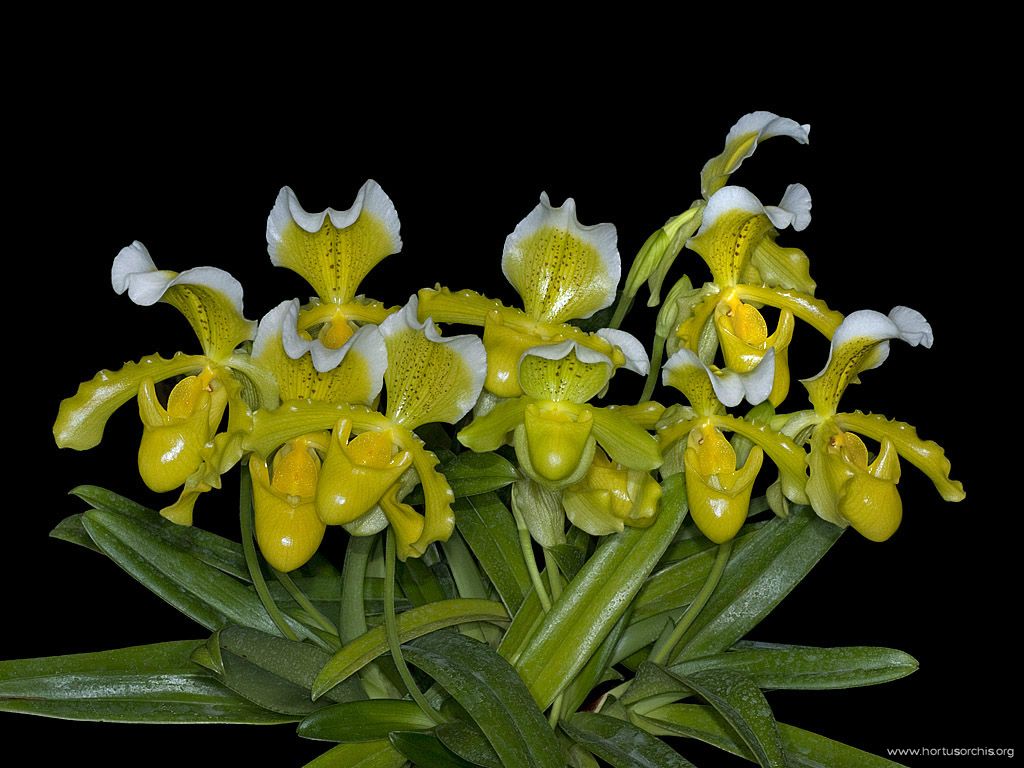
| Paphiopedilum insigne, forma sanderae |
photo C. Solimbergo | |
| taxonomy | described by | (Wallich ex Lindley) Pfitzer, Ernst Hugo Heinrich |
| published in | Morph. Stud. Orchideenbl. 11 1886 | |
| forma sanderae | described by | (Reichenbach f.) Gruss, Olaf & Roeth, J. |
| published in | Caesiana, Associazine Italiana di Orchidologia 12 : 62 1999 | |
| family | Orchidaceae | |
| subfamily | Cypripedioideae | |
| tribe | -- | |
| subtribe | -- | |
| genus | Paphiopedilum Pfitzer 1886 | |
| section | Paphiopedilum (Karasawa & Saito) Atwood 1984 | |
| chromosomes | 2n = 26 | |
| metabolism | CAM pathway, stomata of the leaves are open at night. | |
| (K.Silvera, L.S. Santiago, J.C. Cushman, K. Winter - International Symposium on Plant Biology, August 2013) | ||
| it is useful give the soluble mineal nutriens, on the roots. | ||
| native of | origins | India (Assam, Kalimapang) |
| altitude | 1000 - 1500 m (3300 - 4950 ft) | |
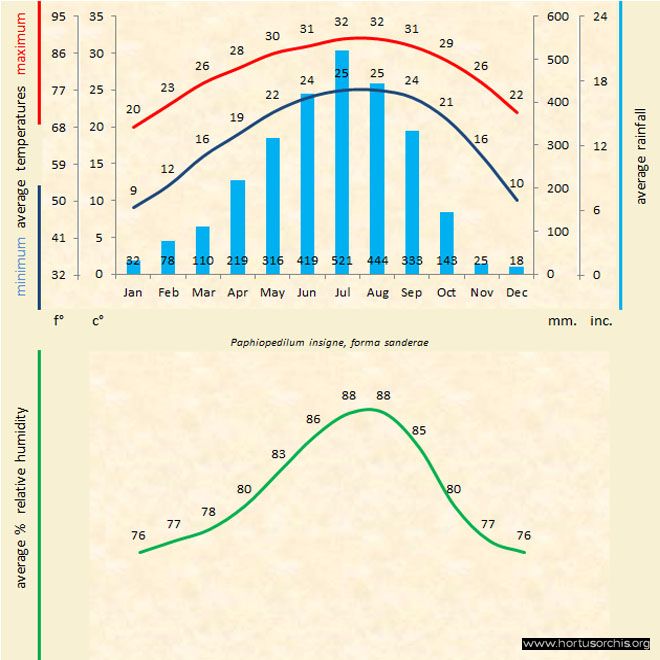
| habitat | climate informations from Dibrugarh (Assam, India) | |
| Köppen climate classification : Cfa, humid subtropical climate in all seasons, with very hot summers | ||
| the weather station data (temperatures are calculated for an altitude of 1250 m / 4125 ft) : | ||
 |
||
| photoperiod | in Dibrugarh this orchid blooms with a photoperiod, which varies during the year, from 12 h 49 m' to 10 h 11 m' | |
| life form | geophyte - on calcareous soil covered with moss | |
| bloom induction need a december or january rest (Lance A. Birk) | ||
| brightness | partial shade to low | |
| inflorescence | length | 10 - 12 cm (4" - 4.8"), from the base of the leaves |
| nr flowers | 1 | |
| size | single flower 10 L 9 cm (4" L 3.6") | |
| duration | single flower, ≈ 35 days | |
| time | to bloom from birth, ≈ 60 - 70 days | |
| CITES | appendix | I |
